Back at the tail end of my teenage years I managed to escape from a town that I found small and limiting. Those of us who had get up and go, got up and went. Since then I have moved back several times and I am writing this now in that town, Newhaven.
When I left at the age of 18 the town was thriving, although it was starting to show signs of slowing down. There were quite a few large businesses on the industrial estates which had factories and other facilities: Fyffes, Christian Dior, Parker Pen, Thorn, Charringtons, Vacco, Artex to name some of them. It had a busy port, with ships loading and offloading a wide range of goods and different grades of ballast. There was a good sized fishing fleet. There were enough pubs to make a pubcrawl ensure that you were falling down drunk at the end of it, if you got round within the World War One opening hours of 7pm to 10.30pm. It had several busy clubs. It had a wide variety of shops and other services. It was also an important link between London and the continent, with regular car ferries meeting up with trains in both Newhaven and its sister port Dieppe. There had been an RAF base with air sea rescue launches until the 70s and there was an RCT base on the opposite side of the river after that.

The devastation to manufacturing industry, the merchant marine and the breakup of British Rail caused by Margaret Thatcher and her colleagues didn’t leave Newhaven unscathed, especially the latter. A lot of the port and the land around was owned by British Rail and a lot of jobs were lost when it was broken up and privatised. Factories started closing and my dad lost his job at Vacco and my sister’s husband-to-be lost his merchant navy job, both shortly before their wedding.

The town centre suffered another fate, pedestrianisation. Shops started closing as people preferred to go somewhere they could drive to. When I was 16 I had a job on a Sunday, delivering papers to eight or nine shops: there’s only two of them left. Bank branches became fewer: now there are none. The Post office has steadily downsized. Pubs became unsustainable and there has been a steady decrease in their numbers. When I was 18 I had the choice of 12 on this side of the river; it’s now five. There is only one club left now, the Railway Club, connected to the railway now by name only.
When I was a child and in my teens I spent a lot of time on the beach. Thanks to the breakwater it was sandy and we had fun there many a time. We swam, built sandcastles and forts which we built up and kept repairing as the sea demolished them. The best for me was when the ferries went out and their wash formed bigger waves which you could dive into and enjoy the struggle with the water. We also jumped off the breakwater and by the steps into the sea, which practice is now called tombstoning (and there are notices forbidding it). The breakwater was used as a promenade and fishermen cast their lines from rods on there, something that I did as a child too. When Maggie’s destruction of the economy had evolved, the new owners, a French company, let the breakwater and the access to the beach deteriorate, ignoring essential maintenance. We tried to get the courts to recognise the beach as a village green but the corruption within the legal system meant that we lost. At some time in the future the breakwater will collapse due to the lack of preventative maintenance, unless expensive repairs are made, and the port and the sandy beach will be lost. The other knock on effect is the loss of the small tourist trade that Newhaven once had.
It’s not all doom and gloom now. The ferry service was resurrected after a hiatus that caused the Gare Dieppe Maritime to be demolished and Newhaven Maritime to be only kept open until recently by a parliamentary train. There are quite a few small factories and other business units on the industrial estates and scrap replaces goods in the port. The windfarm off Brighton has its support base in the port. The pubs that are left have all survived lockdown and are busy throughout the day. For me, there’s a regular bus service to Brighton, which also runs at night Tuesday to Sunday, so I am able to have a good night out with friends in Brighton, or even travel back from London after gigs.

I suppose there are worse places to have been during lockdown but, after visiting friends in Hastings when things had eased off a bit, I realised that Newhaven was a place with very few options on what to do, where to go, where to shop and where to walk and run. I did go shopping in Brighton occasionally, for things that aren’t available in Newhaven. Things didn’t get much better since we started getting back to normal. More shops have closed and another pub has gone and one that should have reopened hasn’t. I want to escape again sometime soon, somewhere that I don’t have to travel far for gigs, events and the little shopping I do.
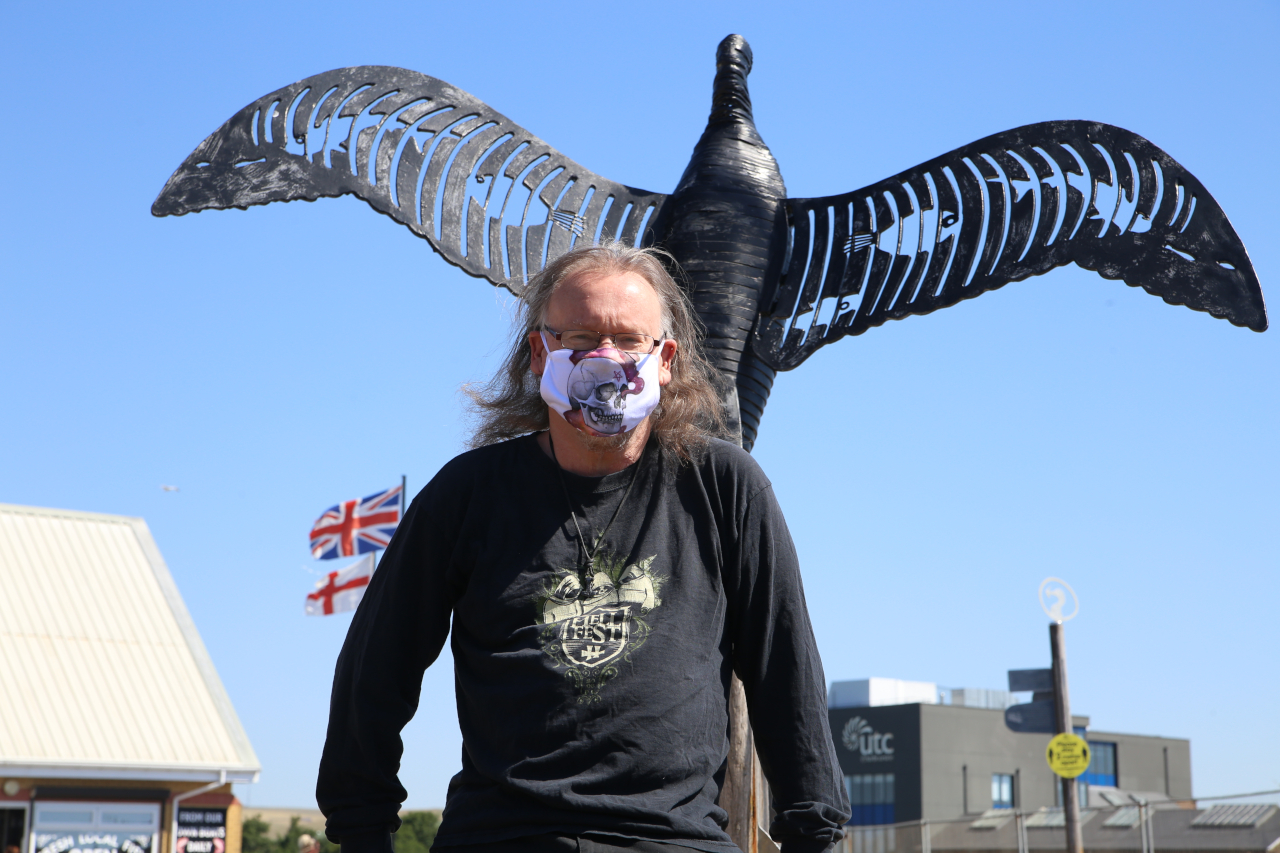
During lockdown we had to wear masks a lot so I bought some with designs by a Canadienne friend Connie. The pics I took wearing them show several places around Newhaven.